
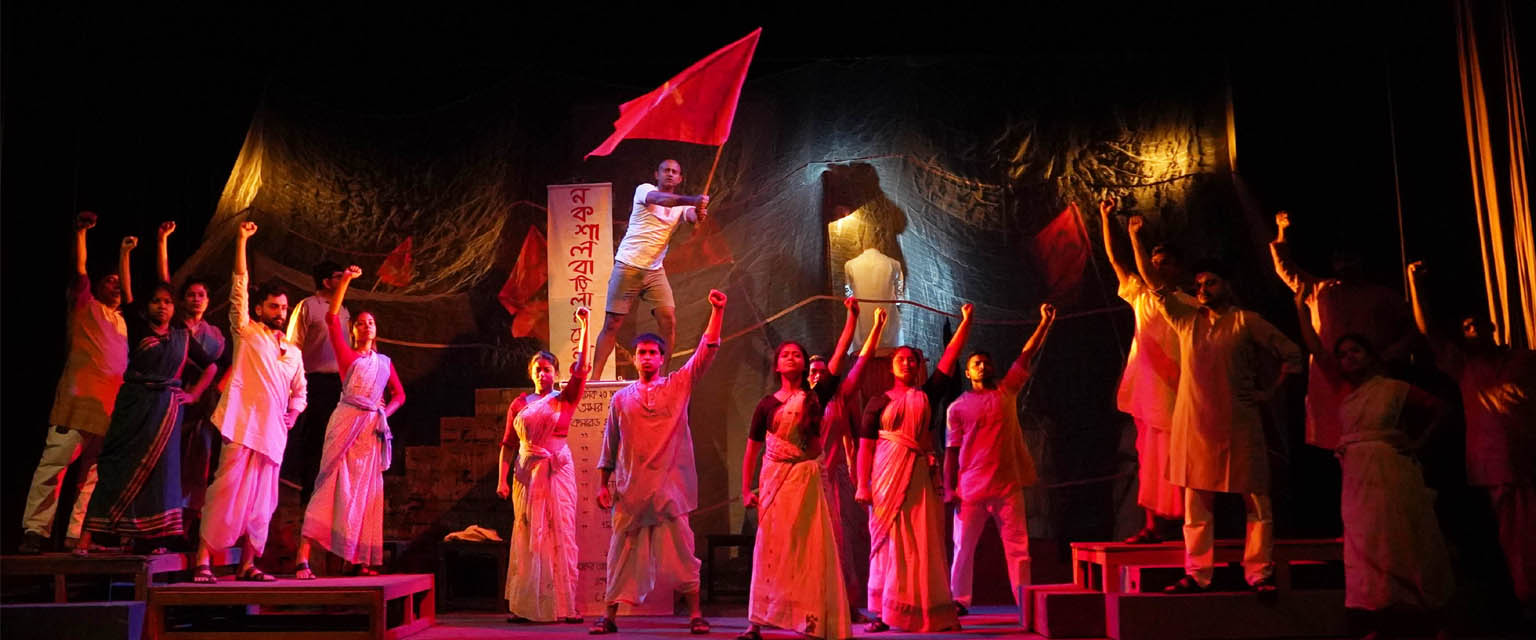
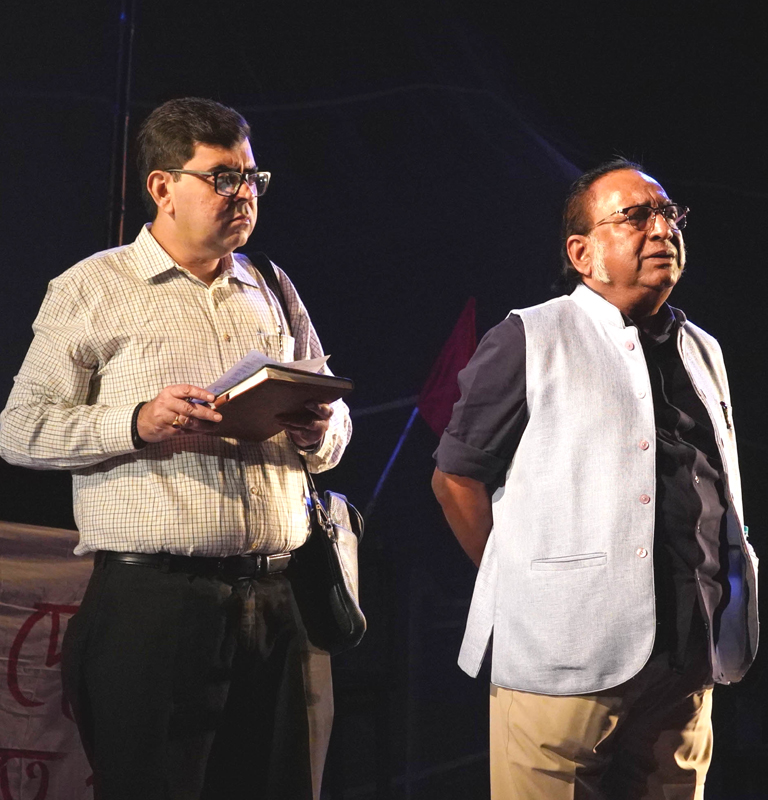
Bosonter Bojronirghosh
Director's Note
Why This Play?
“Since a writer can never truly detach himself from reality, we would want him to engage with his era with enthusiasm—this is his only opportunity. His era is made for him, just as he is made for his era. We will lose nothing of our time; it may not be the best of all, but it is ours. We only have this one life to save, amidst this war, perhaps amidst this revolution.”
Sartre wrote these words while engulfed in the flames of World War II. His play, “The Respectful Prostitute”, written in 1946 against the backdrop of an incident in an American town, was what he called a “theatre of circumstances.” It was about making choices, about how an individual must find ways to liberate themselves in response to their given reality.
The history of Black people fighting against white supremacist racial oppression in Europe and America is well known. In contemporary India, aggressive Hindutva has once again fueled an atmosphere of hatred and division across the country, reminiscent of that history. Just as white terror and anti-Semitism were rooted in racist ideologies of supremacy, the RSS—propagating Hindu caste supremacy based on Manusamhita—has found its political weapon in the BJP, which has raised the flag of triumphant Hindutva in Varanasi under the leadership of Narendra Damodardas Modi. This new wave of communal discord threatens the centuries-old pluralistic heritage of the Indian subcontinent.
At a time when independent India should be moving past the wounds of Partition to focus on the struggles for livelihood, economic inequality, and democratic rights, Hindu fundamentalists are pushing the country towards religious extremism—just as Muslim fundamentalism has led neighboring states into theocratic regression, pulling them back into medieval darkness instead of social and economic progress.
In such times, what should a theatre practitioner do? Should they retreat into the comfortable belief in “art for art’s sake”? Or should they transform the stage into a weapon against this “circumstance”?
This play is, in essence, a humanistic statement against the fascist dominance of the majority.
Synopsis of Play
Waiting for the Second Spring
People generally come in three kinds: those who forge history, those who record it, and those who swarm like flies, feeding on the bloodstained pages of past struggles, yet remaining numbed to its numerous lessons. Instead of remaining indifferent, we wish to build a platform where we can revisit, reanalyze and reimagine these chapters of history in modern ways.
Today in India, conservative, right-wing politics dominate, pushing left-progressive views to the extreme marginals. A century after the founding of two ideologically opposed parties in 1925, one now uses narrow religious nationalism to assault India’s rich legacy, while the other, rooted in international class struggle and meant to stand for farmers, workers, students, and the poor, has lost its way and become almost irrelevant. In this situation, we see no choice but to confront them head-on. In these times, anyone who believes in Marx’s assertion that “the history of all hitherto existing society is the history of class struggles” needs to be revived, and anyone who sees that a state forged by the unholy alliance of government, corporate power, and media can never serve the people’s welfare, must rise up and make their voices heard. We must question this state-corporate-media alliance, because it can never build a truly people-focused nation. Our weapon in this escapade is theatre. Onstage and off, we must wage a nonstop cultural war against this right-wing, fascist movement and its affiliates.
They are trying to silence every democratic, secular voice, from attacking our constitution to trampling on the rights of adivasis, dalit communities and endangering minorities, all part of a new, corporate-colonial dystopia. To stop it, everyone who cares about freedom has to step up. We must unite and put aside abstract ideological divides.
Let the final struggle begin today.
Premiered On: 22nd August, 2025
Cast & Crew of Bosonter Bojronirghosh
- Monika Pandit – Suparna Das
- Mithilesh Joshi – Joyraj Bhattacharjee
- Minister Joshi – Biswajit Chakraborty
- Muslim man – Dipak Halder
- Lakshmanprashad – Subhasish Chakroborty
- Sheokumar – Mrinal Baur
- Man 1 – Supriyo Dey
- Man 2 – Tunir Sarkar
- Chorus Team – Shatadal Chakroborty, Ronit Dey, Subrata Bhattacharjee, Soummyajit Mondal, Karna Chakroborty, Ayushman Halder.
Creative Co-ordinators of Bosonter Bojronirghosh
- Set — Madan Gopal Halder
- Light Design : Soumen Chakraborty
Production Co-ordinators of Bosonter Bojronirghosh
- Production Controller – Karna Chakroborty
- Stage Manager – Ranjit Deb
- Makeup Artist – Sheikh Israfil
- Theatre Marketer – Shatadal Chakraborty
- Graphic Designer – Rajat Dolui
- Projectionist – Badal Shaw
- Backstage Managers – Srijeeta Dutta, Suhasini Dutta, Deblina Roy, Rupsa Mitra, Bhaswati Mukhopadhyay
Technical Co-ordinators of Bosonter Bojronirghosh
- Music Composer – Dishari Chakraborty
- Music Operator – Somdutta Ghosh
Creators
- Playwright – Jean-Paul Sartre.
- Adaptation – Angshuman Bhowmik
- Art Director — Hiran Mitra
- Director – Biplab Bandyopadhyay
Acknowledgement
Special Thanks – Kazi Nazrul Islam, Faiz Ahmed Faiz,Rahat Indori, Arman, Amir Khusrow,Shani Arshad, Rahat Fateh Ali Khan, Amjad Sorbi, Sneha Khanwalkar,Rashid Khan,Vidya Shah, Suvendu Maity,Tapas Chakraborty, Kanhaiyalal Kumar,Pujan Sahil,Niranjan Sadan and Calcutta Youth Choir